Building a Production-Grade URL Shortener: Architecture, Metrics, and Motivation
The Motivation
Have you ever wondered how services like Bitly or TinyURL handle millions of redirects with near-zero latency? I set out to build a production-grade URL Shortener platform to solve high-throughput challenges: unique ID generation, scalable database access, and sub-50ms redirect paths.
Long URLs are unwieldy. They break in emails, look messy in social posts, and are hard to remember. A URL shortener creates a clean interface while also enabling analytics: who clicked, when, and from where.
The goal was to build a system that not only works, but is structurally sound for horizontal scaling, stateless authentication, and fast lookups.
Code Space
3.52 Trillion
Redirect Latency
< 50ms
Code Generation
< 1ms
Architecture
4-Layer N-Tier
Technology Stack
- Backend: Node.js and Express.js
- Database and ORM: Drizzle ORM + SQLite (migrated from PostgreSQL)
- Authentication: Stateless JWT + bcryptjs
- Validation: Zod schema validation
- Frontend: React (Vite) + Tailwind CSS
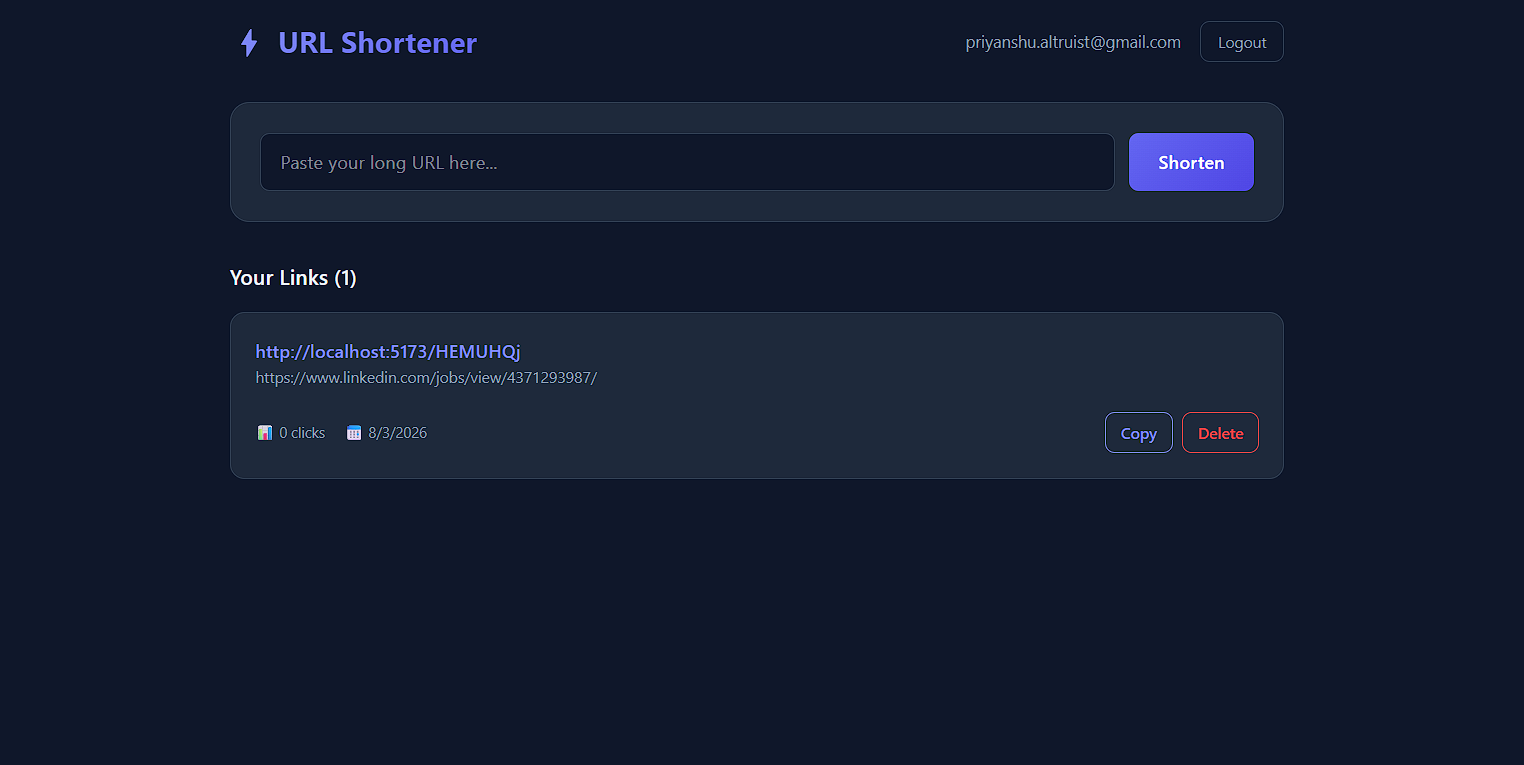
A Look at the Platform

High-Level System Architecture
Core Engineering Decisions and Metrics
1) Retry Pattern for Collision Resistance
Short codes are generated with a 7-character NanoID from a 62-character alphabet (~3.52 trillion combinations).
On uniqueness conflict, a retry loop regenerates the code up to 5 attempts to maintain reliability.
Metric: Generation latency under 1ms, with near-zero collision failure rate.
2) Indexed Lookups with B-Tree
The redirection endpoint is the critical performance path. A B-Tree index on short_code avoids O(N) scans as data grows.
This keeps lookup time stable and protects redirect performance under increasing traffic.
Metric: End-to-end redirect latency under 50ms.
3) Asynchronous Write-Behind Analytics
Click analytics updates are dispatched asynchronously so redirects return immediately without waiting for database writes.
This preserves user-perceived speed while still recording engagement data in the background.
Metric: Analytics adds near-zero perceived redirect latency.
4) Stateless Authentication
JWT-based stateless auth avoids centralized session bottlenecks.
Any backend node can verify requests, enabling cleaner horizontal scale-out.
Final Thoughts
Building this URL shortener was a deep architecture exercise. The migration from Docker PostgreSQL to SQLite proved how resilient layered design can be: data-engine changes were isolated without rewriting core business logic. The result is a fast, robust platform ready for real-world usage.