Project Nexus: Building a Multi-Agent Intelligence Architecture
The Motivation Behind Nexus
Large language models are powerful, but most AI applications still follow a single-agent pattern: one prompt in, one output out. That pattern fails when we move into real production complexity.
Complex systems like autonomous workflows, research assistants, hiring systems, coding agents, and decision engines are solved by teams of specialists, not a single mind. Project Nexus was built from that idea.
Core question: what would an AI system look like if it behaved like a collaborative team instead of a single model?
What is Project Nexus?
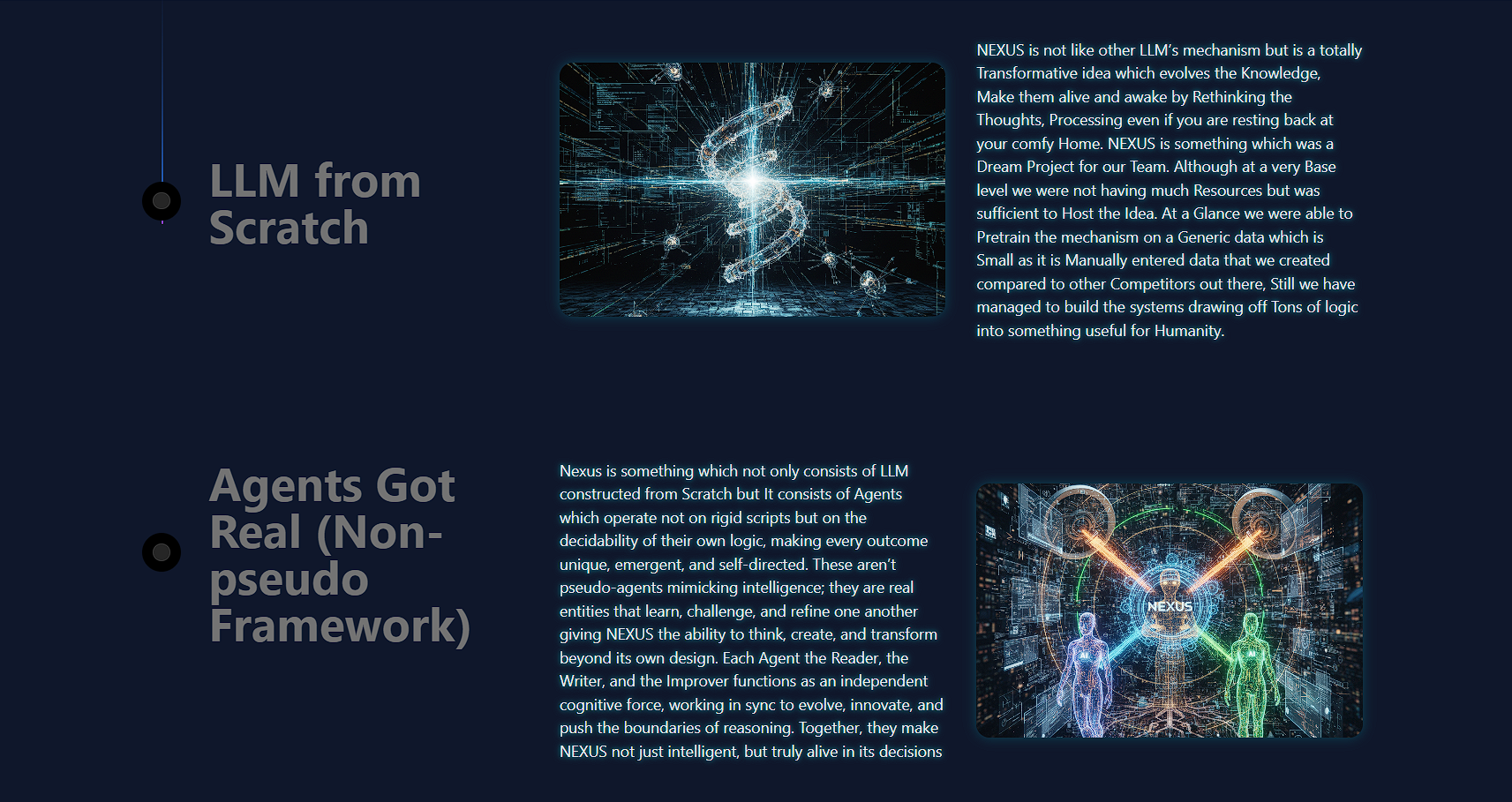
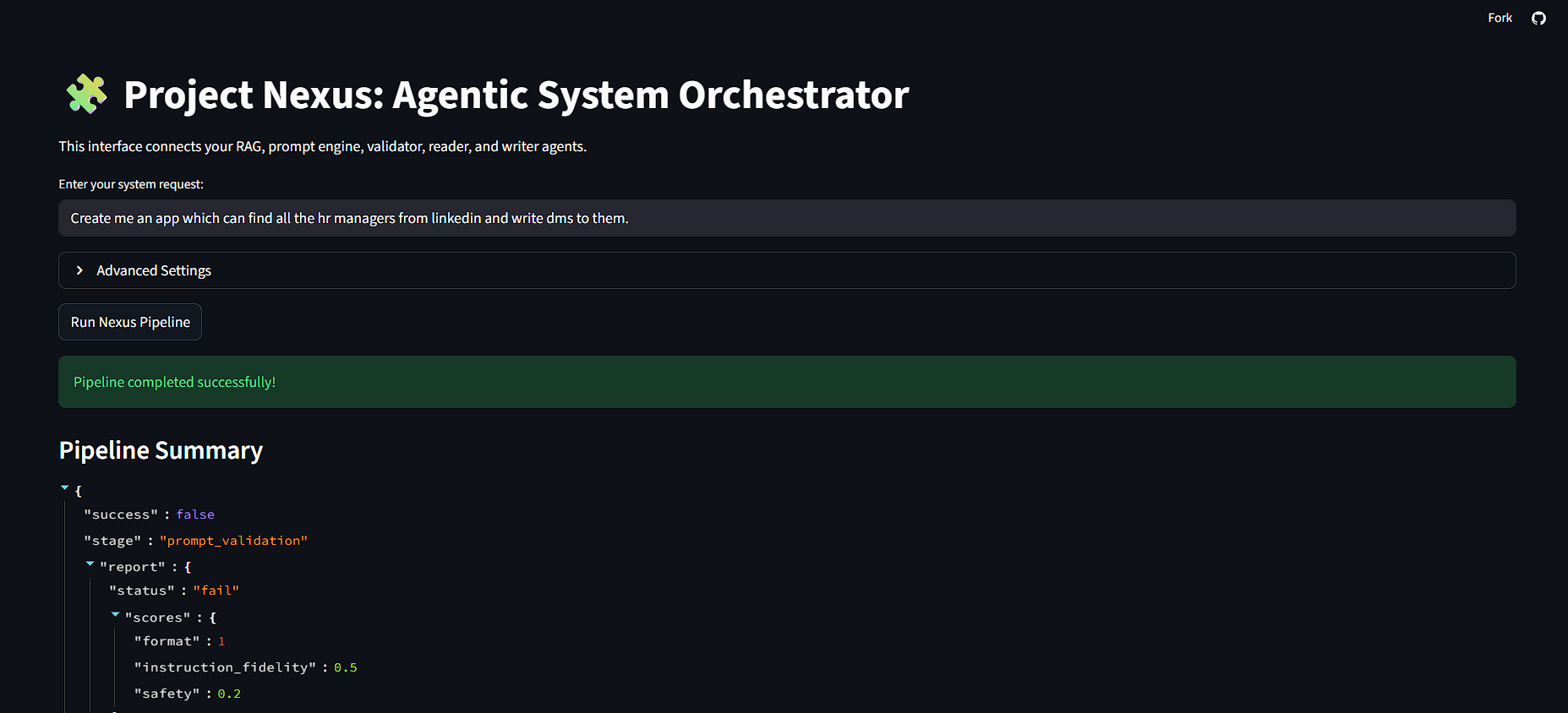
Project Nexus is a multi-agent intelligence architecture where specialized agents communicate, share context, retrieve memory, and self-correct through a validation loop. It behaves less like a chatbot and more like an autonomous cognitive network.
Specialization
Each agent has a clear and scoped responsibility.
Coordination
An orchestrator manages sequence, routing, and delegation.
Memory
Retrieval systems give the architecture continuity beyond a single prompt.
Project Nexus Visuals
High-Level System Architecture
User Interaction Layer
Handles user prompts, structured requests, metadata attachment, and session setup before handing control to orchestration.
Agent Orchestration Layer
Routes tasks to the right specialists, controls execution order, and coordinates inter-agent messaging.
Reasoning Layer
Runs specialized agents such as Planner, Research, Execution, and Critic to solve complex requests collaboratively.
Memory and Knowledge Layer
Supports retrieval-augmented reasoning using embeddings, vector databases, and semantic recall pipelines.
Infrastructure Layer
Backs the system with FastAPI services, vector storage, relational metadata stores, and async execution patterns.
Agent Orchestration Layer
The orchestrator controls task routing, communication, sequencing, and decomposition. It keeps the agent network deterministic and transparent.
| Task | Agent |
|---|---|
| coding | Code Agent |
| analysis | Research Agent |
| evaluation | Critic Agent |
{
  "agent": "research_agent",
  "task": "information_retrieval",
  "context": "...",
  "memory_refs": []
}Reasoning, Memory, and Infrastructure
Planner, Research, Execution, and Critic agents form a self-correcting loop. Memory runs through a pipeline of ingestion, chunking, embeddings, vector storage, and semantic retrieval. The infrastructure combines FastAPI, vector databases (Pinecone/Weaviate/Chroma), relational metadata, and asynchronous execution.
Communication Flow
User Query
  ->
Request Parser
  ->
Agent Orchestrator
  ->
Planner Agent
  ->
Research Agent -> Memory Retrieval
  ->
Execution Agent
  ->
Critic Agent
  ->
Final Response
Lessons Learned and Future Direction
- - Structure beats clever prompts.
- - Memory is essential for context continuity.
- - Multi-agent systems require strict orchestration.
- - Structured outputs improve debugging and trust.
Future work includes stronger communication protocols, persistent long-term memory, better evaluation benchmarks, and dynamic agent creation. The long-term vision is clear: AI systems will be networks of intelligent agents working together.